The work that actually makes excellence happen
mindset
Update to last week’s 360 email: though 2 days later than planned, we made it to see Tiffany and her baby :) It was an afternoon of cuddles, smiles, and laughs!
I was in California, going through boxes in my childhood home and memorabilia from what seems like a past life: school yearbooks and projects, trips, music festivals, graduation and college albums, photos I found of me with Sabine Meyer, Placido Domingo, Rostropovich...
I also came across my old clarinet notebooks with exercises, notes and reed scraping instructions from lessons and masterclasses across the years. (Plus lots of pics of old friends who are now long-time colleagues)!!
And I remember the tedious work in the practice room. The feeling comes flooding back with one glance at these notebook pages. I found sticky notes of one audition season — where I was preparing with that year’s winter olympics in the background. The notes read: you’re an Olympic star! focus like Michelle Kwan!
Those highlight moments played in my head like a hype reel. But...
We have to remember that behind those highlight moments were years of the most boring, repetitive work imaginable. Rep 47 of the same landing drill, or the 293rd time perfecting a hand position. Showing up on Tuesday morning at 4:30am to do the exact same warmup routine, again.
So the thing I want to talk about this week is this: Excellence isn’t exciting. Excellence is boring.
And that’s precisely why most people never achieve it.
We’re drawn to the big moments — the audition win, the standing ovation, the job offer. But excellence isn’t built in those moments. It’s built in the decision you make in measure 247 of a Mahler symphony when no one’s listening and your mind is wandering. Or training yourself in daily scale practice to maintain your air support even when going into tricky altissimo f# minor. It’s built on those sleepy afternoons when you’re tired and would rather scroll through your phone.
James Clear talks about this in Atomic Habits — the idea of “1% improvements.” If you get 1% better every day for a year, you end up 37 times better than when you started. Not 365% better — 37 TIMES better. Because these tiny improvements compound.
But the boring news is that the 1% improvements are almost invisible in the moment. They’re unexciting, unglamorous, and easy to dismiss.
Staying positive after a cracked note is a small 1% improvement. Maintaining steady air support through a mental slip is another 1%. Choosing to stay present in your sound for one more rep when you’re exhausted is another.
And most often, these don’t feel like wins. They feel like... Wednesday. A typical practice between class and dinner.
But these “boring” choices are literally where excellence lives.
Non-negotiables
Olympic athletes have non-negotiables — the fundamentals they maintain no matter what. Form stays perfect even on rep 97. Breathing pattern stays consistent even when the body is screaming to stop.
A good friend of mine, an author, wakes up every morning at 5am to write.
One of my trombone colleagues shows up exactly an hour before rehearsal to warm up.
Mine is feeling (not thinking) into what is true for me. It took a lot of training and practice to get here (maybe some of you resonate with this!). Not outside expectations, not from a place of needing to be liked, and not from a place of pressure. But what I truly want, need, like, am excited by, love.
The recovery drill
This week, I want you to be boring. Seriously.
Here’s the drill:
Play any scale or passage you’re working on
When you make a mistake (wrong note, crack, squeak, falter)
WITHOUT STOPPING OR REACTING, keep your bow/air/flow steady and continue
Notice the urge to tense up, stop, grimace, or apologize with your body
Choose the small win: and get back immediately to steady, supported air motion
You’re practicing the passage, but on top of that, you’re practicing excellence (steadiness) when something goes wrong. This is a nervous system rewire. You’re keeping one thing consistent no matter what happens around it.
Track it. Put a tally mark for each time you successfully maintain air through a mistake. Watch these boring, unglamorous small wins accumulate.
After a week, you’ll notice something: you’re not just better at being steady (though you definitely will be). You’re also calmer, more resilient, not prone to being derailed by mistakes. You’ll be more focused on what you can control!
Pick your non-negotiable for the week. Is it a consistent embouchure, relaxed shoulders, good posture? Is it being non-reactive?
Cheers to being boring together,
Ixi
Let's work together on building these mental skills — separating identity from results, focusing on controllables, reframing disappointment. These are exactly the type of topics we cover in the CAREER HUB (along with career, artistry, wellbeing and business for you the modern musician)!
Inside, there's the Professional Development Certificate, the THRIVE MEMBERSHIP, lesson and coaching opportunities, support, community, answers, action blueprints, and resources with a personal touch.
Scholarship is available, email me and we'll talk!
|
|
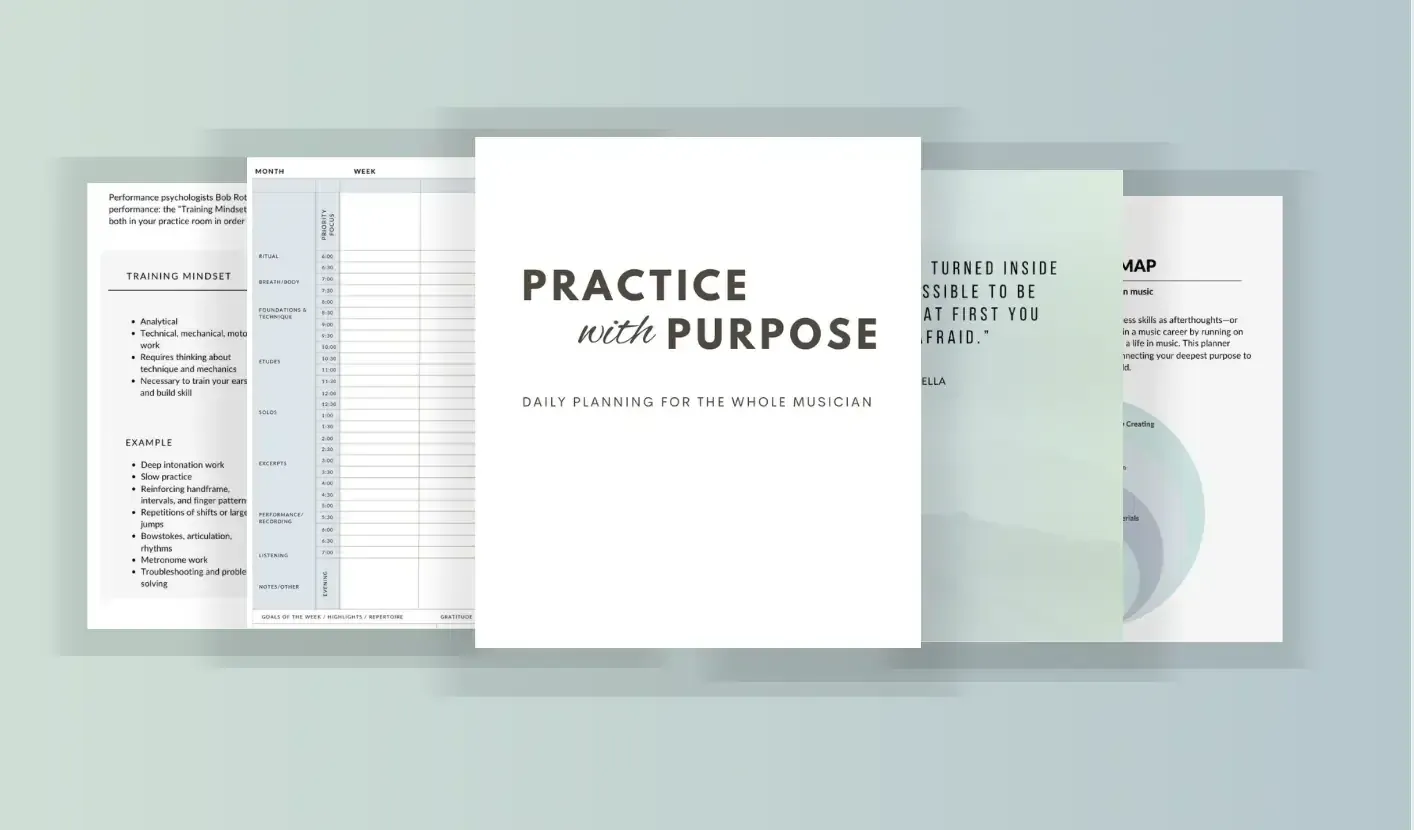
The Practice with Purpose framework is $99 fo 2 6-month planners! It includes:
- the complete framework ($37 system)
- your 2 physical planners included (a $80 value, shipped to your door)
- training modules and ongoing resources
A system built on alignment, connection and flow.